
By Ross Motter
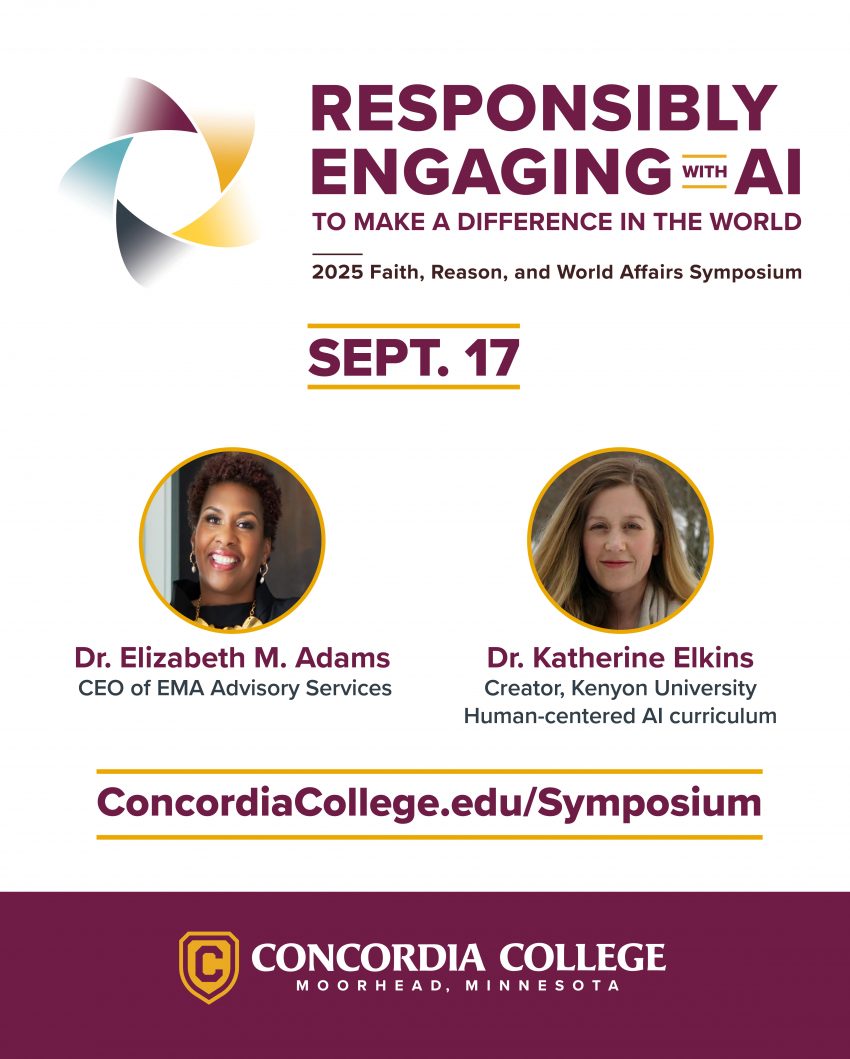
MOORHEAD — Amid the buzz of computer-generated information, Concordia students, staff, faculty and community members are gathering this week at the Faith, Reason and World Affairs Symposium, “Responsibly Engaging with AI to Make a Difference in the World.”
On Wednesday, Sept. 17, the 38th annual Faith, Reason and World Affairs symposium will be taking place across Concordia’s campus, focusing on a pressing issue to secondary education, Artificial Intelligence, or AI. This symposium is diving into the pedagogical and practical aspects of generative AI and how to use AI ethically in the classroom.
Joe Kennedy, one of the five co-chairs of this year’s symposium, hopes that students get exposed to a lot of the different uses of AI, the ethical responsibilities of AI, and trying to answer the question of what it means to be human in the world of artificial intelligence.
Outside of being a co-chair for this year’s symposium, Kennedy also serves as an instructional designer, academic technologist and coordinator and the coordinator of AI initiatives at Concordia.
The public release of ChatGPT in November of 2022 led to the “AI Critical Questions Group” being formed on campus, where they looked at a plethora of applications of AI.
“If generative AI leads to artificial general intelligence, did we just play God?” Kennedy said. “And if so, how does that impact our relationship with the divine.”
Two months after the creation of this group, a second group was formed. The new group focuses on the pedagogical and practical aspects of generative AI and how to instruct AI in the classroom.
Several faculty members, according to Kennedy, reached out to members of both groups and said that this should be a symposium topic.
“Those of us involved with those groups kind of all looked at each other like, ‘I’m not doing it if you don’t do it,’ and that’s why we have five co-chairs, which seems like an unwieldy model.”
Another co-chair, Per Anderson, emeritus professor of religion and global learning, started at Concordia College in 1986, one year before the Faith, Reason and World Affairs Symposiums started. He is also part of the AI Critical Questions Group with Kennedy.
Per, unlike Kennedy, is not a heavy Artificial Intelligence user. Instead, he has been “trained as a scholar, but a student of technology,” who is looking at the symposium plenary speakers, Elizabeth Adams and Katherine Elkins, from the lens of understanding humanity.
“You’ve heard the phrase of ‘becoming responsibly engaged in the world,’ and so in picking Dr. Adams, we picked someone who is right there, right now, in the midst of helping organizations engage in responsible use, getting right at the critical questions.”
Elizabeth Adams is an AI influencer who helps organizations navigate the complexities of AI.
Located in Minneapolis, Adams has served as the CEO of the MN Responsible AI institute, which helps educate citizens across the state about Responsible AI (RAI) practices.
She has collaborated with leaders and organizations to help them align with ethical AI practices. She is also an author, where she is currently working on “The Worker and Artificial Intelligence,” which will explore AI, the workforce, and how they intersect.
Adams’ session will be focusing on the responsibility of users of AI tools, called “Leading What’s Next: Stewarding the 6th Wave of Innovation.”
Katherine Elkins, professor of Comparative Literature and Humanities at Kenyon College, works in both applied and theoretical humanities and social sciences. She has a focus in AI, ethics, and cognitions, according to her Kenyon College profile.
Her session, “What’s Actually Coming with AI (and Why You Need to Help Shape It),” focuses on the intersection of technology and the humanities, and how AI systems will impact students.
Elkins is one of the leading women speaking on interdisciplinary AI usage, speaking to college students across the country since 2019, and had led to being chosen, according to Anderson.
“We picked Dr. Elkins because of the particular expertise that she has,” said Anderson. “We are also steering our work here at the college toward ensuring that we have an opportunity here to develop leaders who can be responsible in their use of AI.”
Two sessions of concurrent sessions will also be held: “How AI Affects Us” and “Our Responsibilities Regarding AI.” The morning sessions focus on hyper-individualized formats, including music composition, AI therapy bots, medical bots, policing and literature. The concurrent sessions will include a Q&A period with the plenary speakers, panels on various applications of AI and how to measure AI’s progress.
