
By Brigit Wuolle
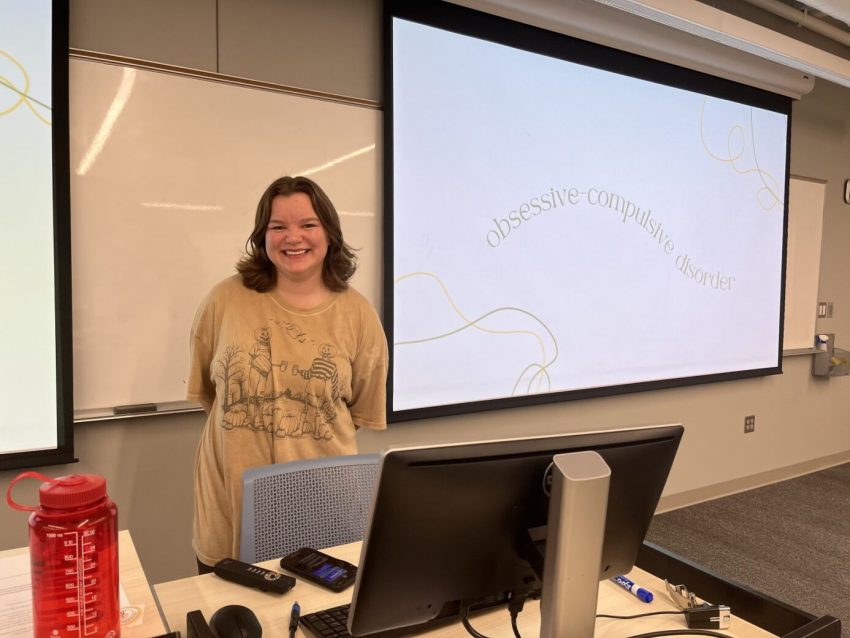
On Thursday, Oct. 9, Psychology Club hosted an awareness event on obsessive-compulsive disorder (OCD). The vice president of the club, Weslee Terry (pictured), gave a presentation where she shared facts about OCD as well as her own personal experience.
This event is part of a larger series of events that the Psychology Club will host in the future. Qwame Martin, president of Psychology Club, spoke about the reasons behind this series. He said, “I want to create an environment where psychology students can meet, hang out, and also ask the dumb questions.”
Attendees of the OCD event were able to ask anonymous questions that were answered by Terry after her presentation was over.
When asked about why Psychology Club decided to put on an event about OCD, Terry said, “I just feel like it’s important to spread awareness and destigmatize something that seems kind of gross and scary.”
Martin said, “[OCD] is one of those disorders, similar to bipolar disorder, which is misunderstood but also overly used.” He used an example of someone saying they have OCD when they’re really just a “clean freak.”
Terry also touched on this common misconception. She said, “It’s not just being clean.”
OCD is a cycle with an obsession, a thought, and a compulsion, something done to ease the fear around that thought. OCD thoughts are “ego-dystonic,” meaning that they are inconsistent with morality or self-concept. Terry said, “The whole point is that you don’t want to be thinking these things.”
Some of the subtypes of OCD that were covered at the event include contamination, checking, and counting, though there are a multitude of others.
Terry explained that seeking reassurance is a symptom that is seen across all subtypes of OCD. Providing reassurance to someone with OCD may seem like the best thing to do, but Terry pointed out that it contributes to the cycle of obsessions and compulsions. Seeking reassurance can be seen when, for example, someone with OCD asks someone else to check their food to ensure it isn’t contaminated.
“If you take anything away from this,” Terry said, “just do not reinforce the cycle.”
Another point that Terry covered is the prevalence of comorbidities in people diagnosed with OCD, which are medical conditions that co-occur alongside OCD.
Nine in ten adults with OCD report comorbidities such as generalized anxiety disorder, major depressive disorder, bipolar I and II, attention-deficit/hyperactivity disorder, eating disorders, and autism spectrum disorder.
Closely related disorders include hoarding, trichotillomania (pulling out hair), and excoriation (picking at skin).
Terry also emphasized the importance of treatment for people with OCD. The main treatment options are therapy and medication. Types of therapy can include exposure and response prevention (ERP) and acceptance and commitment (ACT). Mindfulness, like breathing exercises, can also be used to cope.
As part of her main takeaways at the end of her presentation, Terry pointed out that many people with OCD may not “seem” like they have OCD. Terry said, “We seem normal because we are.”
