By Madi Wimmer
Several Concordia students remain on campus over winter break. This year, a little over 30 students will stay for the full break, with about 70 staying for part of it. To support those students, the Center for Holistic Health, Dining Services and Residence Life have coordinated resources to ensure students have access to mental health care, food assistance and basic needs throughout the quieter weeks.
The Center for Holistic Health
The Center for Holistic Health (CHH) will be closed Dec. 23 through Jan. 2. While the office will be closed, support does not disappear. Students still have uninterrupted access to TimelyCare, a free 24/7 virtual medical and mental health service available through Concordia login credentials.
Heather Simonich, director of the Center for Holistic Health, said students often underestimate how helpful TimelyCare can be during break. “Even though the campus is closed, TimelyCare has a crisis response plan and can contact Concordia if a student needs in-person support.”
Simonich noted students sometimes assume support ends when buildings close, but virtual care remains fully available. She encouraged students to reach out for mental and physical health needs during break, especially if they feel isolated. CHH also recommends staying active and connected by using the Olson Forum for exercise, attending community events in the Fargo-Moorhead area, and relying on free MATBUS transportation.
Food and Dining
Food access remains a major concern for students who stay on campus. The Cobber Food Pantry stays open during the semester portion of break, but closes when campus officially closes. To support students staying on campus, CHH is providing food boxes. Eligible students received sign-up information by email.
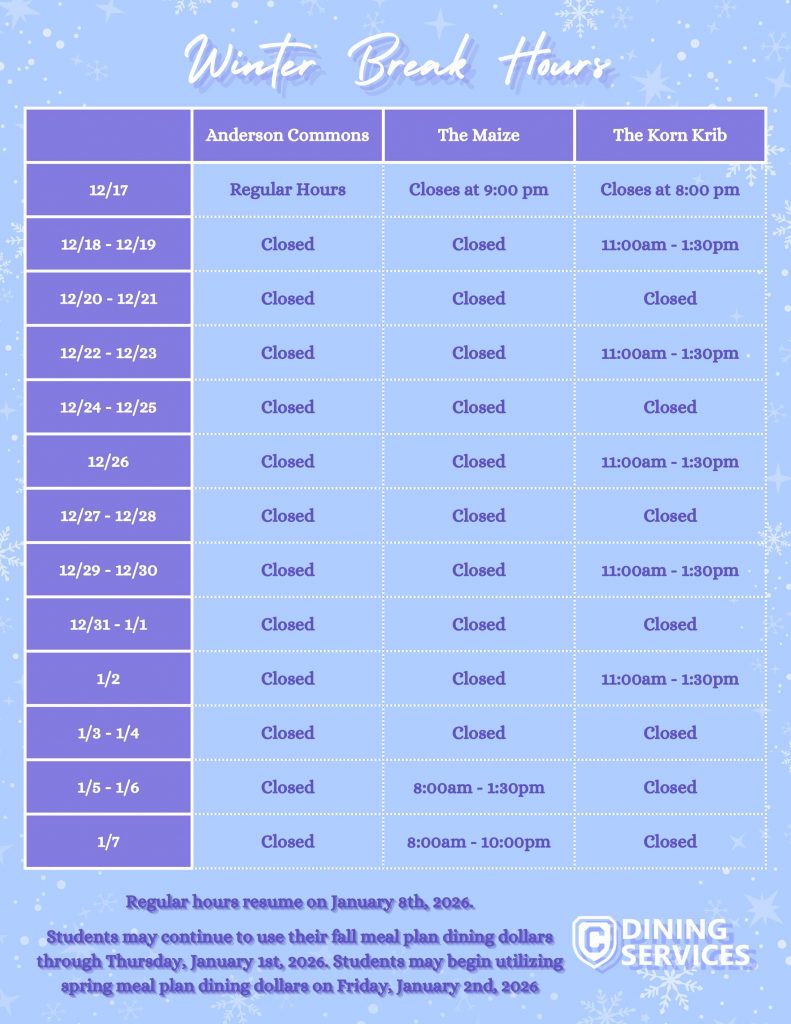
Dining Services is preparing for the reduced traffic during winter break. Anderson Commons will be closed Dec. 18 through Jan. 8. The Maize will reopen Jan. 5 after being closed for most of break. The Korn Krib will operate on a limited schedule and is the only Dining Services location open on select days.
Janet Despard, director of Dining Services, said past usage helps determine what remains open. “We review business volume from previous years to decide which locations stay open and how many hours we can offer.”
Winter break business is extremely low compared with the academic year. Despard said that during the week between Christmas and New Year’s last year, the Korn Krib averaged only two transactions per day. “Even with low traffic, we continue to open the Korn Krib during this time for students who may be challenged to get food elsewhere.”
The Korn Krib also adjusts inventory for break by stocking mostly nonperishable foods and items with long shelf lives. Despard said students with dietary restrictions can contact the Registered Dietitian Nutritionist ahead of break so Dining Services can ensure appropriate items are available.
Students who face food insecurity can also request meals through the Cobber Food Pantry. Despard said, “Students can access meals through the Cobber Food Pantry. We are grateful to the Student Government Association for their organization and support of this project.”
Housing
Residence Life also plays a significant role during the winter break period. Although traditional residence halls close, the college offers designated winter housing for students who need to stay. These students live in specific halls that remain staffed and accessible throughout the break.
Even with fewer students present, Residence Life maintains safety protocols and access restrictions. Only approved students have fob access to buildings, and Student Subdirectors staff a 24-hour duty rotation. Subdirectors conduct nightly rounds, answer calls, and serve as the primary point of contact in the absence of Hall Directors, who are off during break. Public Safety is available at all times for urgent situations.
Tonya Purdy, student support coordinator, encourages students to remain connected to avoid feeling isolated. Even small interactions, such as sharing meals, attending events together, or checking in with friends, can make the break feel less isolating.
Sean Payette, Director of Residence Life, said, “Students can sometimes feel disconnected and lonely when staying over break, so we recommend they reach out, stay connected, and make use of available support.” He emphasized, “Students should never hesitate to reach out. We want everyone staying on campus to feel safe, supported, and connected.”
Although winter break services are more limited than during the school year, Concordia continues to provide essential resources. Students staying on campus are encouraged to use TimelyCare for medical or mental health needs, visit the Korn Krib during its adjusted hours, sign up for CHH food boxes, use the Cobber Food Pantry when open, and connect with Residence Life staff when needed. Staying informed and using available support can help make the long break more manageable and less isolating.