
By Megan Noggle
Barry Auditorium is full to bursting Wednesday morning. Light filters in through the windowed walls, illuminating the room within. Students lean against the walls and take up the standing room, for the many seats have long been filled. More trickle in late, one-by-one, lining up outside the doors themselves. They strain their necks and duck their heads, trying to catch a glimpse of the large screen at the very front of the room. Below the screen is a raised stage, and on it is Darin Ulness, a professor of chemistry at Concordia.
Though this is merely an offshoot of the main symposium session this year, it might very well be mistaken for the main event.
Artificial Intelligence (AI) has been a controversial topic on campus, and a symposium topic surrounding it has only ignited the discussion. Now, students flood in to hear about its physical harm — one of the few official concurrent sessions the campus dedicated to discussing the topic.
“AI AND THE ENVIRONMENT” labels the session in bold red letters via a small white sheet on the double doors.
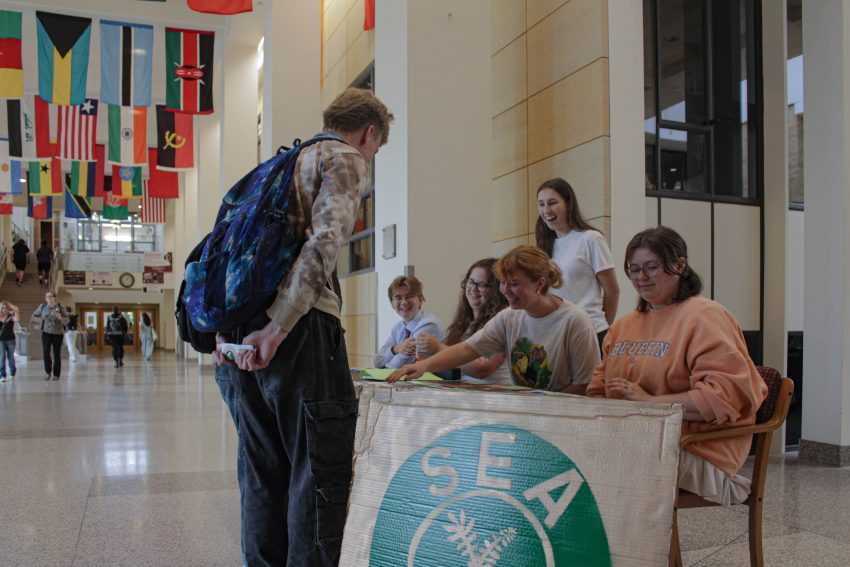
On the opposite side of campus, a pair of tables line the hall of the Knutson Campus Center (KCC). Strung up by ribbon, punched paper letters spell out “IS THIS AI?” in differing shades of blue and green. Printed pictures of beautiful landscapes line the table, each one numbered, one through 10, with corresponding green notecards.
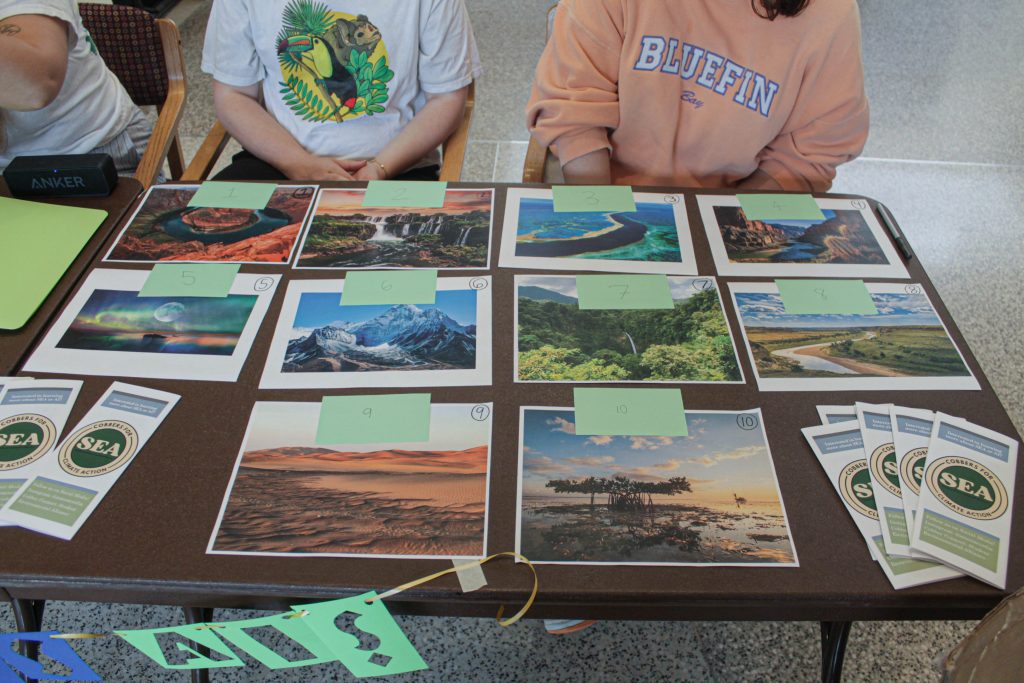
A student chooses an artificial-looking photo: green and blue neon lights decorate a sky with a too-large moon. The notecard is turned over to reveal that photo five… is a real photo of Voyageurs National Park. Though perhaps a bit edited, the members attending the station admit, it is not AI.
All around campus from the beginning of the week, photos have popped up prompting students to guess if what they’re looking at was real or generated by a machine. An uncanny man watches over the halls of Knutson; a set of four pugs greet students walking into the library. Yet more often than not, they do not exist.
This replica activity was inspired by these campus-sponsored images. In those cases, there was an equal chance that what was presented could be AI or real. Yet in this event, held by the Student Environmental Alliance (SEA), no AI has been used at all. Every photo is real.
Some participants go through four or five photos before they catch on. Only one guessed the gag from the get go.
“There are some things that AI just cannot replicate, and that’s the natural world,” Delaney Clagget, the president of SEA, said. “Some things are just too natural to be generated by technology.”
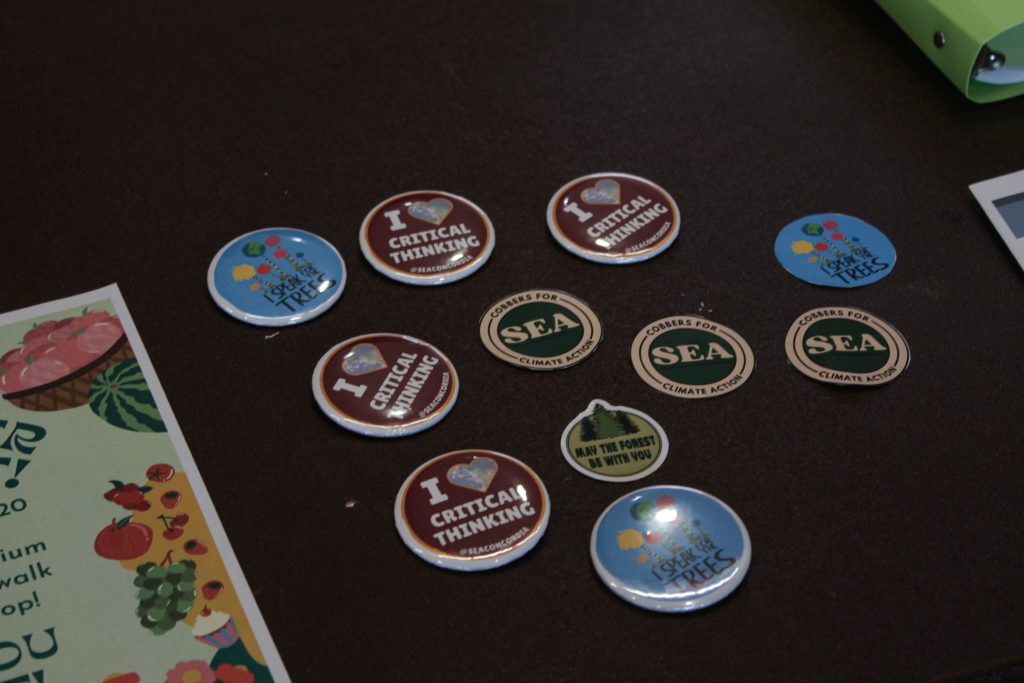
Off to the left of the photos, on the adjoining table, pamphlets are laid out. Above them, a small pile of home-made buttons. They read “I speak for the trees” and “I heart critical thinking”.
Hours later, crowds reconvene in Barry Auditorium in slightly smaller numbers. Four students sit atop the stage now behind long, blanketed tables, the large screen powered off. To the right side, two students mutter back and forth. They, like the pair of assenting students, are dressed spiffily in suits — one brown, one navy blue. They are here to argue against the implementation of AI in education. Their opposing pro-AI team’s suits are a matching dark green with red ties. Their attire is intentionally Seussian, as they draw inspiration from The Onceler in more ways than one.
Together they make up the Concordia Debate Team, running the only official symposium event with a party dedicated to opposition. The students spend the better part of an hour presenting their arguments to the waiting audience, one at a time, from behind a tall podium.
“They (scantrons) use paper,” says the shorter Onceler, “which is inherently wasting trees and they’re expensive. They need to be replaced.”
“Is paper use better or worse than carbon dioxide being put out into the air?” The opposition rebuts. The audience responds with sharp snaps and knocks of applause. “The environmental impact of AI was not mentioned in this debate other than there, but it is significant and should be addressed in further debates of this matter.”
